
Tifini Goebel, Notary Public & Apostille Services
Power of Attorney Apostille in California
Need a Power of Attorney apostilled for use outside the United States? I provide California Power of Attorney apostille processing for documents notarized by a California Notary Public, with standard and expedited service available.
If your Power of Attorney has not yet been notarized, I also provide mobile notarization throughout San Mateo County and Santa Clara County before coordinating the apostille. If it has already been properly notarized in California, you can mail or deliver the original document to me for processing.
I review the document for California apostille processing requirements and coordinate submission to the California Secretary of State. You are responsible for confirming the receiving country's requirements with your attorney, consulate, embassy, or requesting authority before the document is notarized and submitted.
When You Need a California Power of Attorney Apostille
A California Power of Attorney may require an apostille when it will be presented to a government agency, financial institution, business, attorney, or other authority outside the United States.
Common reasons include:
-
Buying, selling, or managing real estate in another country
-
International banking and financial transactions
-
Business representation and corporate matters
-
Estate, inheritance, and probate matters
-
Immigration or residency applications
-
Family and personal matters
-
Legal or administrative proceedings abroad
The receiving country or requesting authority determines the type of Power of Attorney required and whether the document needs an apostille, authentication, translation, witnesses, or additional legalization. Confirm these requirements with your attorney, consulate, embassy, or requesting authority before the document is signed and notarized.
Need a Rush Power of Attorney Apostille?
Expedited California apostille service is available for eligible Power of Attorney documents, with a 1–2 business day service option based on my current schedule and workload. Rush Power of Attorney Apostille Service.
Power of Attorney Apostille Pricing in California
Every Power of Attorney is reviewed before processing to identify any California notarization or apostille requirements. If your document has not yet been notarized, mobile notarization can be coordinated before apostille processing.
5-7 Business Days
Standard Apostille Processing
California apostille processing for an eligible Power of Attorney.
$185.00 First Document
+ $75 for each additional in the same order
1-2 Business Days
Expedited Apostille Processing
Expedited California apostille processing for an eligible, time-sensitive Power of Attorney.
$245.00 First Document
+ $75 for each additional in the same order
Need Your Power of Attorney Notarized First?
Mobile notarization is available throughout San Mateo County and Santa Clara County. California notary fees are $15 per notarized signature, plus the applicable mobile travel fee.
California Secretary of State fees, notarization, travel, local pickup or delivery, and return shipping are additional when applicable.
State Fees
California Secretary of State fees are separate from my service fees:
$20 per apostille
$6 special handling fee per different public official's signature authenticated for in-person submissions
Return Delivery Options
Local pickup or delivery available
FedEx domestic return shipping available
International return shipping available via FedEx or DHL
Shipping costs are quoted based on destination and service level
California Power of Attorney Apostille Requirements
Power of Attorney documents may grant broad authority or authority limited to a specific transaction or purpose.
-
General Power of Attorney — Grants broad authority to another person to act on the principal's behalf in matters specified by the document.
-
Special or Limited Power of Attorney — Grants authority for a specific transaction or purpose, such as handling a real estate transaction, banking matter, business transaction, or other defined task.
I can notarize and coordinate apostille processing for an eligible Power of Attorney, but I cannot advise you on which type of Power of Attorney to use, prepare the document, or determine what authority it should grant. Confirm the required document and its contents with your attorney or the receiving authority before your notarization appointment.
General vs. Special California Power of Attorney
A California Power of Attorney is commonly prepared in one of two forms:
General Power of Attorney — Grants broad authority to act on another person's behalf for a wide range of financial, business, or personal matters.
Special (Limited) Power of Attorney — Grants authority only for specific transactions or a limited purpose, such as the sale of real estate, managing a bank account, or signing documents for a particular matter.
I review your Power of Attorney for California apostille eligibility and coordinate submission to the California Secretary of State when appropriate. I cannot determine whether you need a General or Special Power of Attorney, and I cannot advise whether your document will be accepted in another country. The receiving country, attorney, consulate, embassy, or requesting authority determines the document requirements and whether the completed document will be accepted.
California Power of Attorney Apostille Examples
Below are examples of California apostilles issued for different types of Power of Attorney documents. The apostille authenticates the signature and official capacity of the qualifying public official associated with the document; it does not certify or approve the contents of the Power of Attorney.

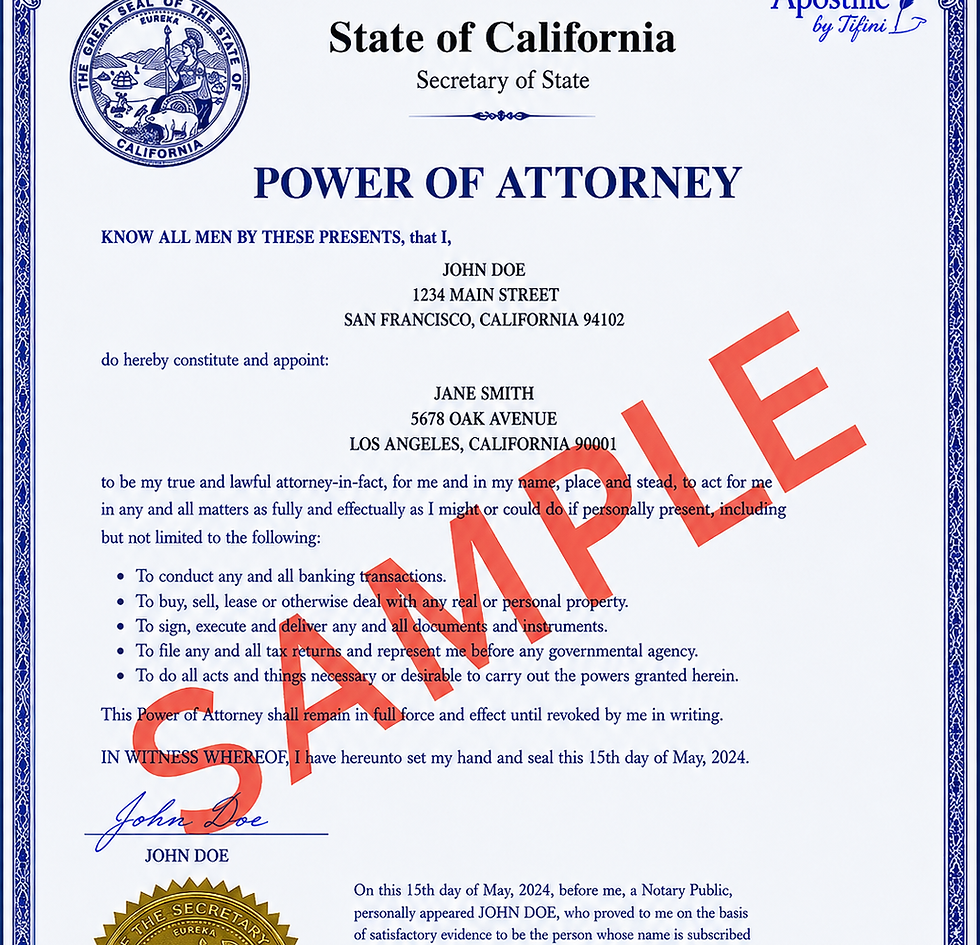

Special Power of Attorney –
California Apostille Sample
Power of Attorney –
California Apostille Sample
Corporate Power of Attorney – California Apostille Sample
Power of Attorney Apostille vs. Authentication vs. Legalization
The process required for a Power of Attorney depends on the destination country.
Apostille
For countries that participate in the Hague Apostille Convention, an eligible California Power of Attorney receives an apostille from the California Secretary of State. The apostille authenticates the California Notary Public's signature and authority.
Authentication & Embassy Legalization
For countries that do not participate in the Hague Apostille Convention, the Power of Attorney may require additional authentication followed by legalization through the destination country's embassy or consulate.
Not sure which process applies?
Tell me the country where the Power of Attorney will be used when requesting your quote. I can identify the appropriate document-authentication route while you confirm the receiving authority's specific requirements for the Power of Attorney itself.
How the Power of Attorney Apostille Process Works
1. Send Your Power of Attorney for Review
Send a clear photo or scan of your Power of Attorney using the quote form. I review the document for California apostille processing requirements and provide a quote based on your document and requested turnaround time.
2. Complete Notarization, If Needed
If your Power of Attorney has not yet been notarized, mobile notarization is available throughout San Mateo County and Santa Clara County. If it has already been properly notarized by a California Notary Public, you can mail or deliver the original document to me for processing.
3. Choose Standard or Expedited Service
Choose Standard Service (5–7 business days) or Expedited Service (1–2 business days) based on your deadline and my current availability.
4. I Coordinate California Apostille Processing
I handle submission of the eligible notarized Power of Attorney to the California Secretary of State for apostille processing.
5. Your Completed Documents Are Returned
Once processing is complete, your Power of Attorney and attached apostille are securely returned by tracked shipping, or local pickup or delivery can be arranged.
Power of Attorney Translation Requirements for International Use
If your Power of Attorney will be used in another country, the receiving authority may require a certified or sworn translation. Confirm the required language and type of translation with the receiving country, attorney, consulate, embassy, or requesting authority.
When both an apostille and translation are required, the apostille should be completed first so the complete apostilled document can be translated together, unless the receiving authority provides different instructions.
Important for Spanish-language documents: The term Notario Público should not be used in a translation to describe a California Notary Public. In many Spanish-speaking countries, a Notario Público is a legal professional with authority that differs significantly from the role of a California Notary Public.
I can coordinate professional certified translations in more than 130 languages as part of your international document process. Sworn translations can also be coordinated for countries or receiving authorities that require them.
Frequently Asked Questions About Power of Attorney Apostilles in California
Can you apostille a power of attorney in California?
Yes. A power of attorney signed and properly notarized in California can generally receive an apostille from the California Secretary of State. The apostille authenticates the California notary public’s signature and commission; it does not certify the contents of the power of attorney or confirm that the document is legally sufficient for its intended purpose.
How do I get a power of attorney apostilled in California?
First, confirm the requirements with the person, attorney, agency, bank, or property office receiving the power of attorney abroad. The document is then signed and properly notarized in California. The original notarized document is submitted to the California Secretary of State with the destination country and required filing fee. Once issued, the apostille remains attached to the power of attorney for international use.
Does a power of attorney need to be notarized before it can be apostilled?
Yes, a privately prepared power of attorney normally must be properly notarized before the California Secretary of State can apostille it. Although some California powers of attorney may be valid when signed before two qualified witnesses, witness signatures alone do not provide the California public official’s signature needed for the usual apostille process. The receiving country may also have specific notarization requirements.
Does a power of attorney need to be notarized in California?
Under California law, certain powers of attorney may be acknowledged before a notary public or signed before two qualified adult witnesses. However, notarization is generally necessary when the document will be submitted for a California apostille. Powers of attorney involving real estate may also need to be notarized so they can be recorded. Because the required format depends on the document and its intended use, confirm the requirements with the receiving authority or an attorney.
What type of notarization is required for a power of attorney?
The document’s preparer or receiving authority must determine whether an acknowledgment, jurat, or another certification is required. A California notary public cannot choose the notarial act or provide legal advice. Many powers of attorney use an acknowledgment, but requirements can differ by country, transaction, and receiving agency.
Does the person granting the power of attorney need to appear before the notary?
Yes. The principal - the person granting authority - must personally appear before the notary, present acceptable identification, and acknowledge the signature or sign as required by the selected notarial act. The principal usually does not need to appear when the completed document is later submitted for the apostille. Any individual may submit an eligible document to the California Secretary of State on the principal’s behalf.
Can a copy of a power of attorney be apostilled in California?
In some cases. California notaries are specifically authorized to certify a copy of a power of attorney. The original power of attorney must be presented so the notary can make or compare the copy and complete the required copy certification. The notarized certified copy may then be eligible for a California apostille. Before using a certified copy, confirm that the foreign receiving authority will accept one instead of the original.
Can California apostille a power of attorney notarized in another state?
No. California can authenticate only the signatures of California public officials, including California notaries. If the power of attorney was notarized in another state, it must ordinarily be apostilled by that state’s designated authority. A document should not be notarized again solely to obtain a California apostille without first confirming that doing so is legally and procedurally appropriate.
Do I need an apostille or embassy legalization for my power of attorney?
That depends on the destination country. A power of attorney intended for a country participating in the Hague Apostille Convention generally requires an apostille. A document intended for a non-Hague country may require state authentication followed by additional federal and embassy or consulate legalization. The destination country should always be identified before processing begins.
Can I get a California apostille for a power of attorney going to India?
Yes. India participates in the Hague Apostille Convention, so a properly notarized California power of attorney can generally be submitted for a California apostille. Indian banks, property offices, attorneys, and government agencies may have their own requirements concerning wording, photographs, witnesses, identification copies, or registration. Obtain the required power-of-attorney format from the receiving party before notarization.
Does a special power of attorney for the Philippines need an apostille?
A California special power of attorney intended for use in the Philippines will generally require a California apostille when it is notarized by a California notary. However, the Philippine recipient or consulate may require a particular form, witness arrangement, identification copies, photographs, or other supporting documents. Confirm those requirements before signing because an apostille does not correct or approve the contents of the document.
Can a power of attorney written in another language be apostilled in California?
Potentially, yes. A foreign-language power of attorney may be eligible when it contains a properly completed California notarial certificate that the Secretary of State can authenticate. The signer and notary must be able to communicate directly, and the notary must understand which notarial act has been requested. The receiving authority may also require a certified or sworn translation.
How long does a power of attorney apostille take in California?
Processing time depends on whether the request is submitted by mail or in person and on current California Secretary of State processing times. Mailing and return delivery add additional time. Expedited apostille support may be available for urgent international transactions, property matters, banking deadlines, or upcoming travel.
Can a California notary prepare my power of attorney?
No. A notary public who is not a licensed attorney cannot draft a power of attorney, select its provisions, decide which powers should be granted, or advise whether the document will be legally sufficient. The form should come from your attorney, the foreign receiving authority, the appropriate consulate, or another authorized source. Once the document is ready, I can assist with notarization and California apostille processing.
California Apostille Services for Your Documents
California Birth Certificate Apostille
California Marriage Certificate Apostille
Single Status Affidavit Apostille
FBI Background Check Apostille
California Power of Attorney Apostille
California Divorce Decree Apostille
California Death Certificate Apostille
Tifini Goebel · Commissioned California Notary Public
· Certified Apostille Support Specialist Apostille and Federal Authentication Services
· Bonded · $1M Errors & Omissions Insurance