
Dual Citizenship Apostille Guide for California Documents
Updated: Aug 5
If you are applying for dual citizenship through ancestry, marriage, or family lineage, you may be asked to provide apostilled California documents before your records can be accepted internationally.
Consulates and foreign authorities commonly require apostilled birth certificates, marriage certificates, death certificates, divorce decrees, and other official records to confirm identity, lineage, family relationships, and eligibility for citizenship applications.
Understanding the apostille process early can help prevent delays, rejected applications, and missing documentation during your dual citizenship process.
Why Consulates Request Apostilled Documents
Foreign consulates use apostilles to verify that official California documents are authentic and legally recognized for international use.
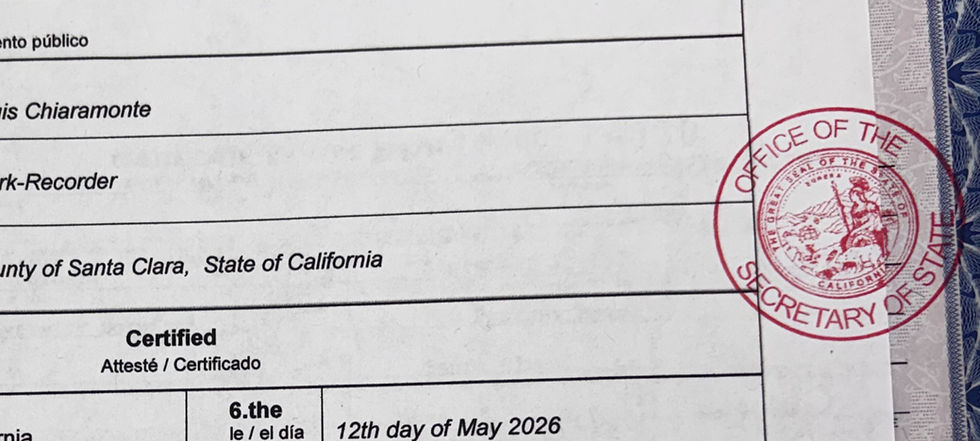
An apostille confirms the authenticity of the public official’s signature on a document, such as a county clerk, registrar, or California notary public.
Consulates commonly request apostilled documents for:
Mexican dual citizenship
Portuguese citizenship applications
French nationality applications
Lineage and ancestry verification
If the destination country is part of the Hague Apostille Convention, the document will usually require an apostille before submission.
Common Documents Needed for Dual Citizenship Applications
Many dual citizenship applications require a combination of vital records and supporting legal documents.
Common apostille documents include:
Naturalization records
Court records
Affidavits
Different countries and consulates may request different combinations of documents depending on the citizenship path and family lineage involved.
California Birth Certificate Apostille for Dual Citizenship
Birth certificates are among the most commonly requested documents for dual citizenship applications.
For California birth certificates:
The document must be a certified copy
Photocopies are not accepted
The certified copy must contain a valid registrar or county clerk signature
The apostille verifies the official signature on the certified record
Some consulates may also require certified translation or sworn translation depending on the destination country.
Marriage Certificates and Divorce Decrees
Marriage certificates are often needed to establish family lineage, surname changes, or legal relationships between generations.
If an applicant was previously married, consulates may also require apostilled divorce decrees or death certificates showing that prior marriages legally ended.
Name consistency across documents is extremely important for dual citizenship applications.
Differences involving:
middle names
hyphenated surnames
spelling variations
maiden names
translation inconsistencies
can sometimes delay consular review.
Certified Translation and Sworn Translation Requirements
Some countries require translated versions of apostilled documents before they can be accepted.
Depending on the destination country, the application may require:
Sworn translation
Apostille of the translation
Country-specific translation formatting
Translation requirements vary by country and by consulate.
For example:
Italy often requires sworn translation procedures
Spain may require strict translation formatting
Mexico may request certified Spanish translations
Portugal may request translated civil records
Italy Dual Citizenship Apostille Requirements
Italian citizenship by descent (Jure Sanguinis) commonly requires apostilled:
birth certificates
marriage certificates
death certificates
naturalization records
Italy may also require sworn Italian translation depending on the consulate or comune handling the application.
Document consistency across generations is critical during Italian citizenship review.
Spain and Portugal Citizenship Apostille Requirements
Spain and Portugal often require apostilled vital records for citizenship applications based on ancestry, residency, or marriage.
These countries may also require:
sworn translations
legalized translations
strict registrar signatures
original certified records
Requirements can vary depending on the consulate or government office reviewing the application.
Apostille vs Authentication for Citizenship Documents
Not every country accepts apostilles.
If the destination country is not part of the Hague Apostille Convention, the document may require authentication and embassy legalization instead.
The correct process depends entirely on:
the destination country
the consulate
the government office handling the application
Using the wrong process can delay citizenship review or cause document rejection.
Common Mistakes That Delay Dual Citizenship Applications
Many delays happen because documents are submitted incorrectly.
Common issues include:
submitting uncertified records
using the wrong document version
notarizing documents incorrectly
missing translations
inconsistent names between records
apostilling documents for non-Hague countries
damaged or detached apostille certificates
Reviewing document requirements before submission can prevent costly delays and resubmissions.
Dual Citizenship Apostille FAQ
What documents typically need an apostille for dual citizenship?
The required documents depend on the country and your eligibility path, but commonly include:
Birth certificates
Marriage certificates
Death certificates
Divorce decrees
Naturalization records
Court records
Powers of attorney
Affidavits
Certified translations
Your consulate or citizenship authority will determine exactly which documents are required.
Why do consulates request apostilled vital records?
Consulates often require apostilled vital records to verify identity, family relationships, lineage, marital status, and eligibility for dual citizenship. An apostille confirms the authenticity of the public official's signature on the document.
Can California birth certificates be apostilled for dual citizenship?
Yes. California birth certificates can be apostilled when they are official certified copies issued by the County Recorder, County Clerk, or the California Department of Public Health. Photocopies are not eligible for apostille processing.
Do marriage certificates need an apostille for dual citizenship?
Many dual citizenship applications require an apostilled marriage certificate to verify family relationships, surname changes, or lineage. Some countries also require a certified or sworn translation of the apostilled document.
Do I need an apostilled divorce decree for dual citizenship?
Possibly. If you or an ancestor were previously married, the consulate may require an apostilled divorce decree to confirm that the prior marriage legally ended. Requirements vary by country and consulate.
Do dual citizenship documents need to be translated?
Many countries require certified or sworn translations of apostilled documents. Translation requirements vary by country, and some jurisdictions require the translation itself to receive an apostille. It's important to confirm the destination country's specific requirements before beginning the process.
What is the difference between an apostille and embassy legalization?
An apostille is used when the destination country is a member of the Hague Apostille Convention. If the country is not a Hague Convention member, the documents generally require authentication and embassy or consulate legalization instead.
Can FBI background checks be apostilled for dual citizenship?
Yes, but through the federal process—not California. FBI background checks are federal documents and generally require authentication through the U.S. Department of State for international use. If the destination country is a Hague Convention member, the document ultimately receives a federal apostille.
What countries commonly require apostilled documents for dual citizenship?
Many countries request apostilled documents as part of citizenship by descent, nationality, marriage registration, or family lineage applications. Common examples include:
Italy
Mexico
Spain
Portugal
France
Colombia
The Philippines
Requirements vary by country and consulate.
How long does it take to obtain an apostille for dual citizenship documents?
Processing time depends on several factors, including:
The type of document
Whether the document is already eligible for apostille
State or federal processing times
Shipping and delivery
Whether standard or expedited service is selected
Because consulate appointments and citizenship deadlines can be difficult to reschedule, it's best to review your documents and begin the apostille process as early as possible.

Mobile Notary and Apostille Services in California
I provide mobile notarization and California apostille support services throughout San Mateo County, Santa Clara County, Palo Alto, Mountain View, Redwood City, Burlingame, San Jose, and surrounding Bay Area communities.
I help clients coordinate:
notarization
apostille processing
document review
certified translation coordination
international document preparation
for dual citizenship and international document use.
Call or text (650) 675-7760 to request a free quote for apostille services.


This was so informal and helped me better understand what I've been looking for. Thank you for writing this blog!